
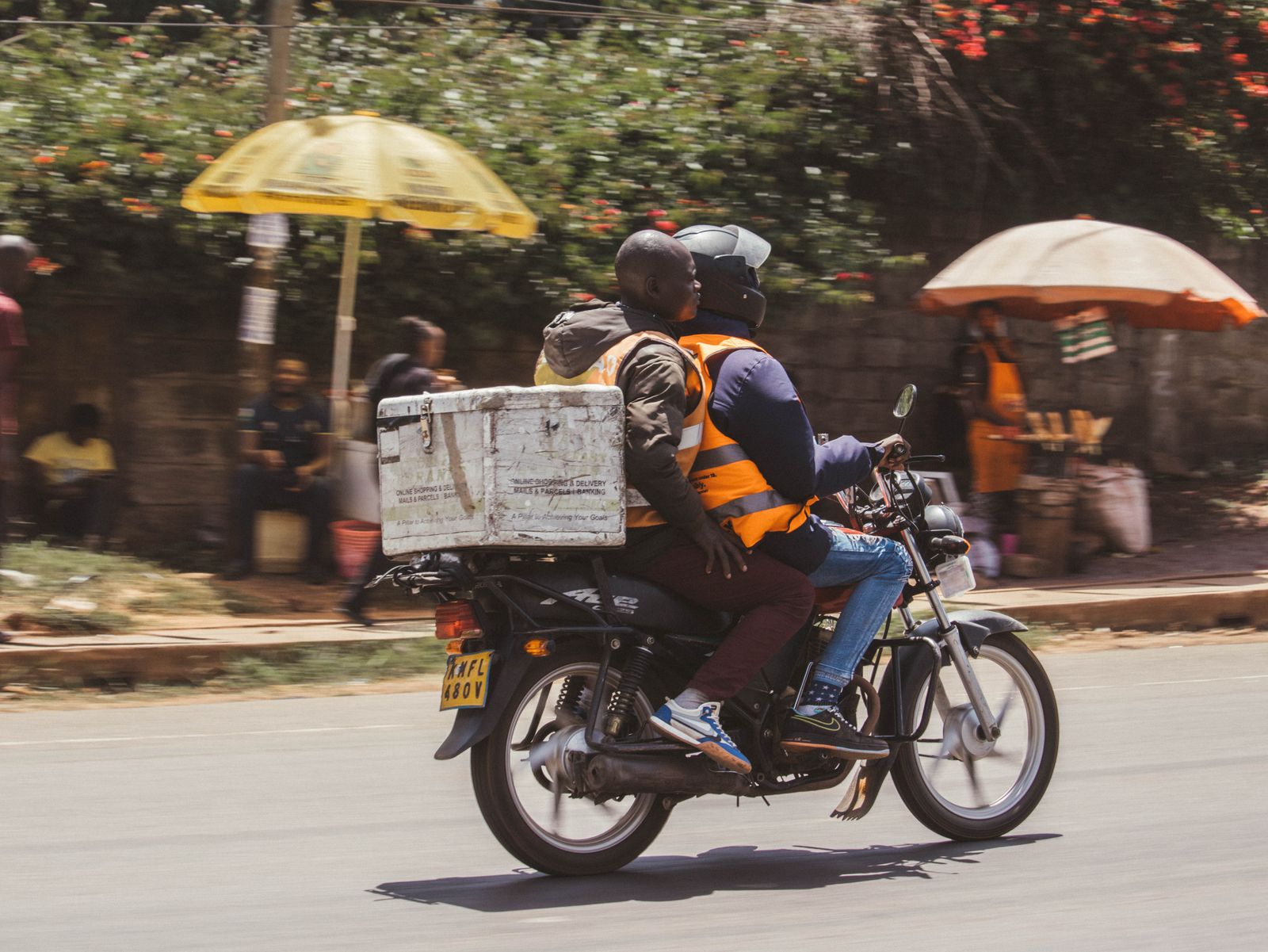
Excerpt: Ghana's motor insurance rules changed twice in 2026 — new Ghana Card requirements, and another premium hike. Most delivery riders know their bike is insured. Fewer know whether that policy actually covers the job they're using it for.
The question that only comes up after the accident
Picture the moment. A rider goes down at a junction in Kaneshie carrying a parcel for a customer who paid for same-day delivery. Nobody's badly hurt, but the bike's front fork is bent and a passing car has a dented bumper. The rider calls their insurer to start a claim.
The first question the insurer asks isn't "are you okay." It's some version of: what were you doing on the bike when this happened?
If the honest answer is "delivering a parcel for payment," and the policy on file says the bike is registered for private use, that single sentence can be the difference between a claim that pays out and one that gets declined — leaving the rider to cover both bikes' damage and any third-party injury costs, personally, out of pocket.
This isn't a hypothetical designed to scare you. It's how motor insurance is built, everywhere, including Ghana — and 2026 has already brought two real changes to Ghana's motor insurance rules that make this worth checking now, not after something goes wrong.
Two things that changed this year, and one thing riders keep missing
1. Your Ghana Card is now required to buy or renew any motor insurance policy. Effective January 1, 2026, Ghana's National Insurance Commission (NIC) made the Ghana Card mandatory for every motor insurance purchase or renewal nationwide — part of a push to tighten Know-Your-Customer checks and cut down on fraudulent policies. If you show up to renew with only your old ID or a photocopy, expect to be turned away until you bring the actual card.
2. Premiums went up again. New Motor Third Party Insurance rates took effect on February 16, 2026. The mandatory third-party premium for motorcycles rose from GHS 302 to GHS 331 — and that GHS 302 figure itself was already a steep jump from roughly GHS 252 the year before, when motorcycle premiums rose by close to 20% in a single adjustment. Put together, a rider paying for third-party cover today is paying meaningfully more than they were paying around this time last year, before you've even gotten to any commercial add-on.
3. The one thing that rarely makes the news: what your policy actually says you're using the bike for. This is the part that matters most for anyone earning money on two wheels, and it's the one nobody sends you a reminder about.
Why "class of use" is the real question, not just "am I insured"
Motor insurance in Ghana — like everywhere else — isn't priced as one flat rate per vehicle type. It's priced against a declared use. You can see this principle already built into Ghana's own third-party rate card for cars: a private saloon car, a taxi, and a hired/rental vehicle are charged three genuinely different premiums, precisely because insurers treat "how the vehicle is actually used" as a real risk factor, not a technicality.
The same logic applies to motorcycles. A policy bought or renewed as private use is priced — and legally scoped — for private use: commuting, errands, personal trips. It is not automatically the same thing as a policy that covers carrying goods for payment, which is what every paid delivery run actually is.
This gap matters because of how most riders end up on two wheels for income. Very few people buy a motorcycle specifically as a "delivery business asset" with commercial paperwork from day one. Far more common: someone already owns a bike for personal use, then starts picking up delivery jobs — through an app, through a social seller's WhatsApp, or informally — without ever updating what their insurer has on file. The bike hasn't changed. What it's being used for has. The policy, if nobody touches it, hasn't caught up.
None of this is unique to Ghana — it's how underwriting works internationally, and it's exactly why "declare your actual use to your insurer" is standard advice for anyone using a personal vehicle to earn income, from delivery riders to rideshare drivers, in any country with a functioning insurance market. Ghana is not an exception to that rule; it's simply where you're riding.
What's actually pushing this into the open right now
This isn't only an insurance-office conversation anymore — it's part of a bigger, slower move to formalize commercial motorcycle use in Ghana altogether. Government proposals tied to the long-discussed Okada Bill would require anyone operating a motorcycle commercially to hold a proper commercial rider's licence from the DVLA, be at least 25 years old, and pass proficiency and safety tests before carrying paid jobs — provisions still working their way toward full nationwide implementation, but very much in motion, not shelved.
Alongside that, independent efforts are already filling part of the gap. The Kick 4 Street Foundation, for example, has partnered with KEK Insurance Brokers to offer riders tailored life and motor insurance packages alongside safety training and formal ID — a real, current example of insurance products built specifically around the fact that a commercial rider's risk profile is different from a private commuter's, and needs to be priced and covered as such. You don't have to go through that specific program, but its existence is a sign of where the market is heading: toward products that actually match how riders use their bikes, instead of riders quietly hoping their old private policy stretches to cover it.
How to actually check where you stand — this week, not eventually
You don't need a lawyer or an insurance broker's office visit to get a straight answer. You need about fifteen minutes and your policy documents.
- Find your current motor insurance certificate or cover note. Look for the section describing the vehicle's registered use — it's usually labelled something like "class of use," "purpose of use," or simply "private" vs. "commercial."
- Call your insurer or agent and ask directly: "Does this policy cover me carrying goods for payment — for example, doing paid delivery work?" Don't accept a vague "you should be fine." Ask them to point to where in the policy that's actually stated, or to confirm it in writing.
- If the answer is no, or unclear, ask what it costs to add or switch to commercial-use cover. This is very likely more than a private-use premium — insurance priced for a higher-risk, higher-mileage commercial use case usually is — but it's a cost you're choosing with full information, instead of a gap you discover after a crash.
- Bring your actual Ghana Card, not a photo of it on your phone from last year, to any renewal or new purchase. Since January 1, 2026, this is a hard requirement, not a suggestion — arriving without it means your renewal simply doesn't go through that day.
- Budget for the new premium. At GHS 331 for standard third-party motorcycle cover as of February 2026, and rising almost every year, this is a cost worth planning around rather than discovering at your next renewal date.
- Remember this is separate from your PCSRC registration. If you've already registered on iCOLMS-GH and gotten your PCSRC Rider ID, that's real progress — but it's a courier-operator registration, not proof of insurance, and one doesn't substitute for the other. A roadside check can, and does, ask about both.
Where this sits for GoPiki riders specifically
To be direct about it: no delivery platform, GoPiki included, buys or arranges your motor insurance for you. Your bike is your asset, registered in your name (or a family member's), and the legal responsibility for having valid, correctly-scoped Motor Third Party Insurance sits with you as the vehicle's owner or rider — exactly the same as it would if you used that bike for any other paid work. The flexibility of choosing your own hours through an online/offline toggle, or picking up jobs across more than one platform, doesn't change who's on the hook if you're stopped without valid cover or in an accident during a job.
That's not a reason to avoid delivery work. It's a reason to spend fifteen minutes this week finding out exactly what your policy actually says — before a rainy Tuesday afternoon in traffic makes the answer matter.
If you're weighing delivery work as an income option, see how GoPiki's online/offline toggle and per-job payouts work for riders — and if PCSRC registration or fuel costs are still open questions for you, those are covered in separate guides. Looking to book a delivery instead? Download the GoPiki app.